Why group psilocybin settings accelerate pro-social bonding
In the modern age, we are more digitally connected than ever, yet many of us experience a profound sense of "relational poverty." We live in a culture that prizes individualism, often at the expense of the tribe.
When individuals seek out psilocybin for healing, they often envision a solitary journey—a mask over the eyes and a pair of headphones. However, some of the most compelling recent research suggests that the presence of "the other" may be one of the most therapeutic elements of the experience.
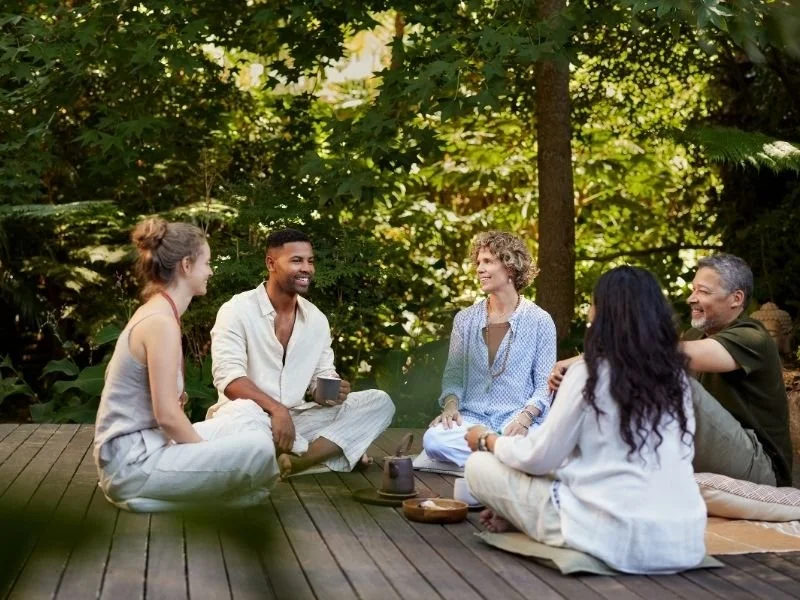
Group psilocybin settings do more than just provide a shared space; they create a unique neurobiological and sociological environment that accelerates pro-social bonding. By stripping away the ego’s defensive layers, psilocybin allows us to move from a state of "I" to a state of "We." Understanding the science behind this shift helps explain why the group container at a retreat can feel like a homecoming for the soul.
The neurobiology of the "social brain"
The amygdala, or the brain's alarm system for potential threats like social judgment or rejection, is what drives our social anxiety. We have been masked in social situations—the masks help us protect ourselves from the potential for rejection and judgment. Research indicates that psilocybin reduces amygdala reactivity, allowing for an easier 'drawbridge' for people to come into their emotional 'fortress.'
Once the fear of judgment is gone, the 'social brain' becomes fully receptive.
Additionally, an increase in serotonin periods typically occur in conjunction with increased oxytocin levels (the 'bonding hormone') following a session. An increase in oxytocin creates the possibility of establishing trust and openness with another individual at a much quicker pace than what would have normally occurred (which can take months or years).
When a group is facilitated in such a way, participants get to see the other participants from a holistic perspective and view each other as mirrors of their humanity, thereby building a closer and more authentic connection.
You can learn more about our group retreats here.
Communitas: The science of shared sacred space
Anthropologists and researchers often use the term "communitas" to describe the intense feelings of togetherness and spirit that emerge during shared rituals. In a psilocybin retreat, communitas isn't just a feeling; it is a measurable psychological state. Studies from the Center for Psychedelic Research at Imperial College London have found that "psychedelic communitas" is a primary predictor of long-term increases in well-being and social connectedness.
When a group undergoes a profound, non-ordinary state of consciousness together, the perceived boundaries between "self" and "other" begin to blur. This shared vulnerability creates a "leveling" effect—regardless of your background, career, or status, everyone in the circle is navigating the same mystery.
This shared journey acts as a powerful catalyst, transforming a group of individuals into a supportive ecosystem where each person’s breakthrough contributes to the collective healing of the room.
Breaking the cycle of social isolation
One of the most debilitating aspects of depression and anxiety is the feeling of being "uniquely broken." This isolation creates a feedback loop where we pull away from others because we believe they cannot understand our pain. Psilocybin, particularly in a group context, provides a direct "antidote" to this belief by fostering a sense of perceived unity.
By hearing others share their intentions and, later, their integrations, participants realize that their "private" struggles are actually part of the universal human condition. This realization—that we are not alone in our suffering—is profoundly regulated by the brain’s social cognition networks. It shifts the internal narrative from "I am isolated" to "I am part of a larger whole," a change that research suggests can lead to lasting decreases in social avoidance and an increased desire for community.
The power of witnessing and being witnessed
The experience of being vulnerable is an important part of human growth because it allows us to heal when others see us during those moments of vulnerability. The process of witnessing that vulnerability has been purposeful in a therapeutic/legal retreat scenario.
When someone shares a thought or emotion within a therapeutic/legal retreat, it creates a moment in which they feel safe expressing those thoughts or emotions and are wholly supported through compassion rather than judgement. When this occurs, the participant's brain begins to develop new expectations of what social interactions will look like.
Corrective emotional experiences are essential to healing. A supportive group environment offers individuals a safe space in which to be themselves and practice who they are authentically, away from the daily scrutiny and potential consequences of that practice.
Although the facilitators maintain the environment, the group atmosphere creates a heartwarming atmosphere, which supports the process of ego dissolution, followed by social reintegration, and creates a warm, embracing, and nurturing experience based on empathy.
You can also read: How does psilocybin affect the body? A research-informed guide for curious seekers
Integration: Bringing the "we" home
The journey doesn't end when the psilocybin leaves the system. The pro-social bonds formed during a retreat often serve as the "scaffolding" for a new way of living. At Confluence Retreats, we believe that the most profound insights are those that are shared. Our group programs are designed to harness the power of communitas, ensuring that your individual path to wellness is supported by the strength of the circle.
For more information and to tailor a program that meets your needs schedule a free Exploration Call and don’t forget to follow us on Instagram. We are committed to providing a safe, nurturing, and transformative experience.
